Buying Guides
Best Thermal Baths in Budapest: Gellért Is Shut to 2028
By the Carefree Retreat team
Updated 2026
Picking the best thermal baths in Budapest got harder in the past year, because two of the names every guidebook recommends are not open. Gellért, the Art Nouveau one on every postcard, closed on 1 October 2025 for a full restoration with a planned reopening in 2028. Király, the small Ottoman bath in Buda, has been closed since 15 March 2020 and its own site still says the closure is for an indefinite period. Plenty of listicles have not caught up.
There is a second change worth knowing before you book flights: several of the main baths now have a minimum age of 14. Rudas states it flatly on its home page, and Lukács carries the same notice. If you are travelling as a family with younger children, the bath you want is not the famous one.
What follows is the current picture, with hours taken from each bath’s own site in September 2026. Hungarian baths change their timetables seasonally, so check the official page in the week you travel rather than trusting any article, this one included.
The state of play in 2026
| Bath | Status | Best for |
|---|---|---|
| Széchenyi | Open | The big outdoor experience, first-timers |
| Rudas | Open | The Ottoman dome and the rooftop tub |
| Lukács | Open | Locals, medicinal water, late Tuesdays |
| Veli Bej | Open | Quiet, small, no crowds |
| Gellért | Closed to 2028 | Nothing until it reopens |
| Király | Closed indefinitely | Nothing |
Széchenyi: the one everybody means
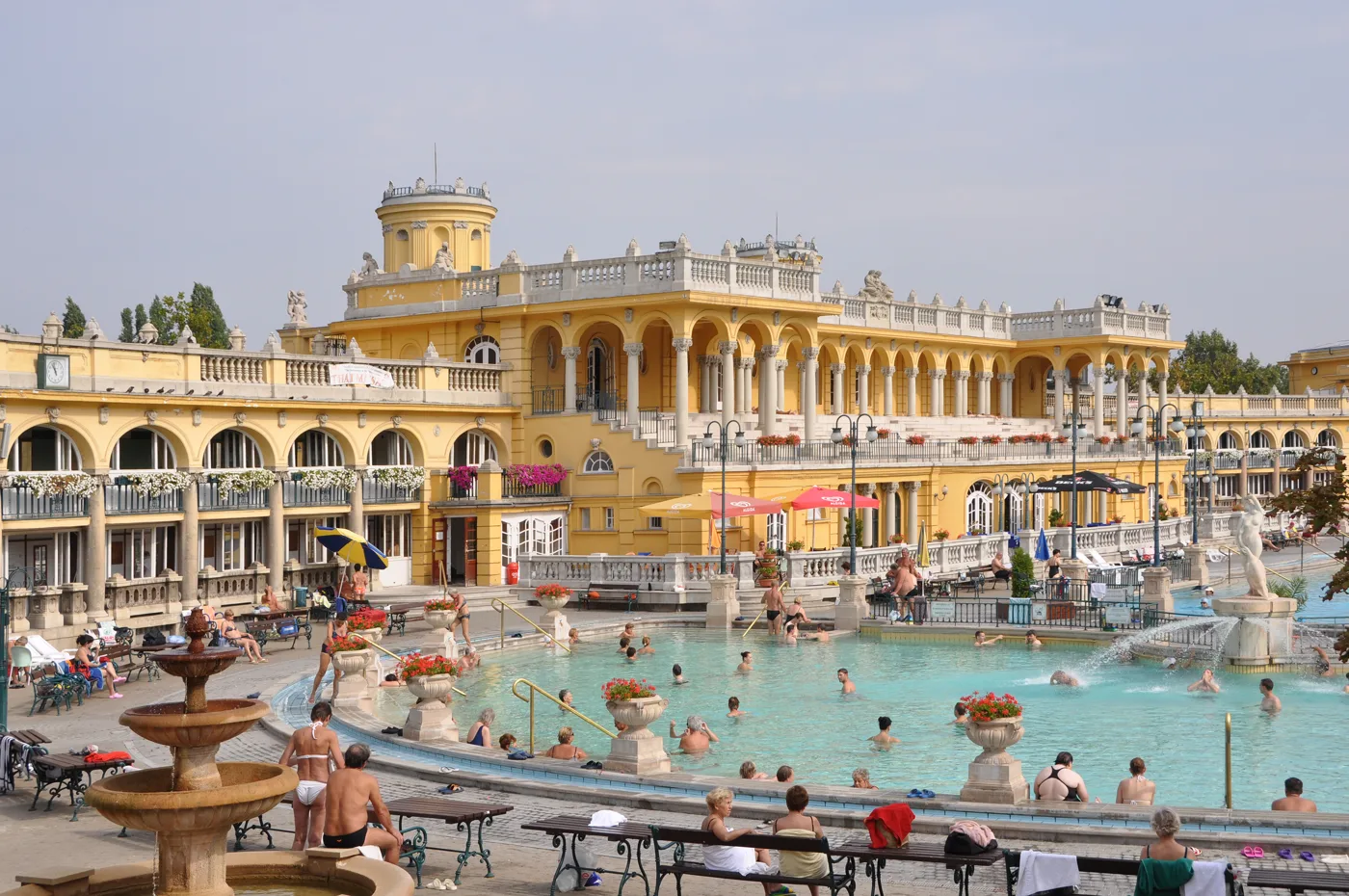
Széchenyi in the City Park is the yellow neo-baroque palace with the outdoor pools and the chess players, and it is the right first choice if you are only doing one bath. The outdoor complex has the two hot thermal pools and the lap pool between them, and the indoor section runs to a long chain of smaller pools at different temperatures plus saunas and steam rooms.
Hours from its own site: 7:00 to 20:00 Monday to Thursday, 7:00 to 22:00 on Friday, and 8:00 to 20:00 at weekends.
Things that will improve the visit:
- Go early or go late. Between roughly 11:00 and 16:00 in season it is genuinely crowded, and the outdoor pools are the busiest part. First thing in the morning is a different place entirely, and Friday evening buys you two extra hours.
- Cabin versus locker. Every Budapest bath sells entry with a locker or with a private changing cabin. The cabin costs more and is worth it if there are two of you, because it gives you somewhere to leave dry clothes and to change without queueing.
- Buy Széchenyi thermal bath tickets online. It is the busiest bath in the city, the desk queue is the worst part of the day in summer, and online entry skips it. Weekday mornings sit at the cheap end of the ladder and weekends at the top.
- The lap pool needs a swimming cap. The two hot pools do not. Caps are sold at the bath if you have not brought one.
- Under-14s are not admitted. This came in during 2025 and applies at Széchenyi, Rudas, Lukács and Dandár.
The “sparty” nights are a separate commercial event held at Széchenyi and are nothing like a normal visit. If you are coming for the water, avoid those dates.
Rudas: the Ottoman dome, and the day of the week matters
Rudas is the one to choose if the architecture is the point. The octagonal Turkish pool sits under a dome carried on eight columns, with coloured glass in the roof throwing spots of light across the steam, and it has been in use since the 16th century. Bolted onto that is a modern wellness wing and a rooftop hot tub looking straight across the Danube at the Pest skyline, which is the single best view from any bath in the city.
The catch, and it is the thing most articles get wrong, is that the historic Turkish bath is not always mixed. From Rudas’s own site: Tuesday the Turkish bath is women only, Wednesday it is men only, and the rest of the week it is open to both in swimwear. Opening hours are 6:00 to 22:00 on Monday and 6:00 to 20:00 for the rest of the week.
Night bathing runs late on Friday and Saturday, and Rudas states that tickets for night bathing are sold online only. Turning up hoping to pay at the desk will not work.
Rudas also has the minimum age of 14, stated on the front page of its site.
Lukács: where the city actually goes
Lukács in Buda is the one Budapest residents use, and it feels it: less spectacular, more purposeful, with a wall of marble plaques left by grateful patients over the past century. The water is medicinal rather than decorative, the crowd skews local and older, and nobody is taking photographs.
Hours from the bath’s own page: 7:00 to 19:00 daily, except Tuesday, when it stays open to 22:00. That late Tuesday is the best-kept secret in the city if you want a hot pool in the evening without the Rudas night-bathing crowd.
Two current caveats from the same page: the private bathtub service and the accessible changing facilities are temporarily out of use for renovation work. Lukács also applies the under-14 rule.
Veli Bej: the quiet one
Veli Bej, under the Buda hills near Margaret Bridge, is a genuine 16th-century Ottoman bath restored to an unusually high standard and run by a religious order rather than the city bath company. Five pools around a central octagon, a very controlled atmosphere, and far fewer people than anywhere else on this list.
That comes with rules. Tickets are sold at the desk on the day rather than online, the ticket runs for a fixed three-hour slot, the bath shuts for several hours in the middle of the day and reopens in the afternoon, and there is a hard capacity limit, so a busy Saturday can sell out in front of you. Go on a weekday morning and it is close to empty.
If your idea of a spa is somewhere calm rather than somewhere impressive, this is the pick. It is the closest thing Budapest has to the atmosphere of a private spa session.
The ones worth knowing about
Dandár is a small, plain municipal bath in District IX with almost no tourists. It is the cheapest way to sit in thermal water in Budapest and it has the under-14 restriction too.
Palatinus on Margaret Island is an outdoor summer complex with slides and grass, and it is the answer if you have children with you, since it is a lido rather than a thermal bath in the medicinal sense. Check its season before counting on it, because the outdoor pools do not run year-round.
Danubius Health Spa Resort Margitsziget is a hotel spa on Margaret Island, connected by tunnel to its sister hotel, and it is the sensible option if you want a treatment-led day rather than a public bath.
What to bring, and what to expect
British visitors are often caught out by the same handful of things.
- Flip flops or pool sliders. Floors are wet stone and nobody walks barefoot between pools.
- Your own towel. Hire exists at the larger baths but the queue for it is another queue. A quick-dry travel towel is the easy answer.
- A dressing gown is optional and useful. The walk between the indoor and outdoor sections at Széchenyi is cold from October onwards.
- A swimming cap if you intend to use the lap pool at Széchenyi.
- A padlock is not needed. Lockers work off an electronic wristband issued with your ticket. It also opens the cabin if you paid for one.
- Card is fine at the main baths for entry and most extras, but carry a little cash for the smaller ones and for the buffet.
On etiquette: swimwear is required everywhere in the mixed sessions, showering before you get in is expected, and the hottest thermal pools are for sitting still in rather than swimming. The saunas at Széchenyi and Rudas are quiet rooms.
On the water itself: these are mineral-rich thermal springs, not chlorinated leisure pools, and the sulphurous ones smell of it. Twenty minutes in a 38 to 40 degree pool is plenty before you cool off, and the baths themselves post that advice. Alcohol beforehand is a genuinely bad idea in water that hot.
If you only have one afternoon
- First visit to Budapest, want the picture everyone has: Széchenyi, first thing, cabin ticket, outdoor pools.
- Care about the building and the history: Rudas, any day except Tuesday or Wednesday if you want the Turkish bath mixed, and pay for the rooftop.
- Want to be somewhere real rather than somewhere photogenic: Lukács, and go on a Tuesday evening.
- Want peace and space: Veli Bej, weekday morning, and accept that you buy the ticket at the door.
- Travelling with children under 14: Palatinus in season, or a hotel spa. The four big thermal baths will turn you away.
Budapest is also the cheapest genuinely world-class bathing city in Europe, which is why it keeps turning up in our roundup of spa breaks in Europe and why it works so well as a solo trip, as covered in our guide to solo spa breaks. If you are packing for it, our what to wear at a spa piece translates fairly directly, with the addition of the flip flops.
Frequently asked questions
Which is the best thermal bath in Budapest? For a first visit, Széchenyi, because the outdoor thermal pools are the experience people come for and it is open long hours seven days a week. For architecture, Rudas and its 16th-century domed Turkish pool. For a bath that feels like the real city rather than an attraction, Lukács.
Is the Gellért Bath open? No. It closed on 1 October 2025 for a full restoration of the whole complex, including the indoor pools, the outdoor wave pool and the spa areas, with a reopening planned for 2028. No firm reopening date has been confirmed.
Do I need to book Széchenyi thermal bath tickets in advance? You do not have to, but you should. Széchenyi is the busiest bath in the city and the desk queue in summer and at weekends is long. Booking online guarantees entry and lets you walk in. Choose the cabin option over the locker if there are two of you.
Can children go to the Budapest thermal baths? Not to the main ones. Széchenyi, Rudas, Lukács and Dandár all now refuse entry to anyone under 14. Families with younger children should look at the outdoor Palatinus complex on Margaret Island in season, or a hotel spa.
Which days is the Rudas Turkish bath mixed? Every day except Tuesday, when the Turkish bath is women only, and Wednesday, when it is men only. The modern wellness section and the rooftop pool are not affected. Rudas publishes this on its own site and it can change, so check before you go.
Do I need a swimming cap in Budapest? Only for the lap pool at Széchenyi, where a cap is required and can be bought at the bath. The thermal pools, the Turkish baths and the rooftop tub do not need one.
How long should I spend at a Budapest bath? Two to three hours suits most people, and some baths sell a three-hour ticket for exactly that reason. Rotating between a hot pool, a cooler pool and a rest of a few minutes is more comfortable than one long soak, and 20 minutes at a time is enough in the hottest water.
Found a place we’ve missed? Tell us about it.
Back to top